Payment Processing 101: How It Works & Why It Matters
In today’s economy, the ability to accept payments flawlessly is the lifeblood of any commercial enterprise. Payment processing is the backbone of any business. It’s the digital infrastructure of checks, balances, and encryptions that confirms every dollar earned is a dollar kept. With a robust provider, your business is protected against fraud. Understanding the basics of credit card processing is essential for sustainable growth in a digital-first business environment.
Your customers are everywhere, and they want to pay in the currencies they know and trust. To succeed in the global market, businesses must bridge the gap between “browsing” and “buying” by providing hassle-free payment options. In this blog, we will take a look at how payment processing works, the importance of payment processing for small businesses, and why to choose Patel Processing.
Key Takeaways
- Payment processing is the digital system that automatically and safely moves money from a customer’s bank account to your business account.
- Every time a customer pays, a group of “players”, including banks, payment gateways, and processors, work together behind the scenes to finish the sale in seconds.
- Modern systems use special encryption so you never have to see or store a customer’s private card numbers. This keeps your business safe from hackers.
- You pay a small fee for every sale. These fees are usually lower when a customer pays in person and higher when they buy something online.
- Most customers now prefer “tap-to-pay” or mobile wallets like Apple Pay. Offering these options helps you grow and keeps your customers happy.
What Is Payment Processing?
Payment processing is the behind-the-scenes technology that ensures your money moves safely and smoothly from a customer to a business. It confirms the transaction, secures sensitive data, and verifies that the payment has been completed successfully. It deals with payment processing methods using credit or debit cards, mobile payments, digital wallets, electronic funds transfer, and Automated Clearing House transfer.
The standard workflow for electronic payments depends on three crucial factors:
- Authorization of the request
- Verification of the user’s credentials
- The final settlement between the banks
Current processing technology has made complex financial transactions possible through rapid exchange. It creates a protected, fast processing cycle between the store’s terminal and the issuing bank. The entire transaction happens in the blink of an eye. The payments automate the communication between the financial institution, eliminating the need for human intervention. As a result, online orders are processed automatically while in-store employees attend to consumers rather than focusing on data entry.
Note: Payment processing is growing at a 14.5% annual rate. You can find the full breakdown in this Market Analysis Report.
The Role of Encryption and Compliance
Modern payment processing is built on a foundation called PCI DSS (Payment Card Industry Data Security Standard). Think of it as a safety guide that helps businesses keep credit card info locked up tight.
When you process payments well, your customers’ sensitive information gets ‘tokenized’ right away. This means their actual card numbers never hit your servers. There is no chance that your data will be hacked or exposed. This way, you will stay focused on your current business without stressing over potential data breaches.
Who are the key players in the Payment Ecosystem?
The payment ecosystem is a blend of technology and rules. It connects to protected software to enable transactions. Whether it’s a small local shop or a massive online store, this setup ensures every transaction is safe, precise, and reliable. Key players in this space include issuing banks, acquiring banks, processors, and gateways, all working together to keep commerce flowing.
This system is always evolving, embracing new tech like digital wallets and fast transfers. On the other hand, global regulators manage the process, ensuring that security and compliance are in place to keep the financial system stable.
Key Participants:
The Consumers:
Individuals or companies that initiate the flow of money. They pay electricity bills, shop online, or send money to a friend, the main users of payment services.
The Merchants:
These are the businesses on the receiving side. They provide and maintain the physical or virtual infrastructure needed to accept payments from their consumers.
Payment Networks & Schemes:
Payment networks are the core of electronic commerce. They provide cards and digital wallets, the technology, and the regulations. These secure networks, operated by brands such as Discover and Amex, allow businesses to pay in a foreign country in seconds.
Issuing Banks:
The Issuing Bank is your personal financial institution that issues a credit or debit card to a customer. They manage your account, set your spending limits, and decide whether to endorse a purchase based on your available balance. When you tap to pay, they’re the ones giving the final “green light” to cover the cost.
The Merchant Acquirer:
The Acquiring Bank is the merchant’s bank. Their role is to verify that all approved transactions receive financing. This is the ‘back office’ function to ensure that the merchant is indeed paid.
Payment Processors:
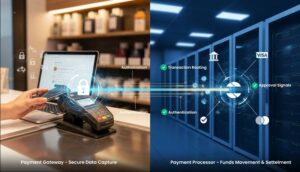
The payment processor handles the entire transaction. They handle the electronic “paperwork” between the merchant and the banks. And, also manages everything from the first swipe to the final deposit. They enable shops to accept cards, wallets, and tap-to-pay. To learn more, read our blog on payment gateways vs. processors.
Payment Gateway:
The Payment Gateway is the middleman that secures the connection between the customer and the bank. It encrypts customer information so banks can process it securely. This process enables real-time authorization and settlement.
Merchant Service Providers:
MSPs are an all-in-one partner for business owners. They provide the whole set of tools: payment gateways, card terminals, and fraud prevention, all in one place. Thus, by partnering with banks on the merchant’s behalf, they ensure every sale is secure, compliant, and hassle-free.
Regulatory and governing authorities:
Digital exchanges operate within a managed system designed to protect you. Major authorities—such as the Federal Reserve, the FCA, and the ECB—serve as guardians of financial stability. They enforce strict anti-money
laundering (AML) laws and data standards, such as the GDPR, to keep your information safe.
How Payment Processing Works: A Step-by-Step Breakdown
We’ve covered the ‘who’; now let’s talk about the ‘how.’ Let’s explore how they work together to complete customer transactions.
Step 1: Customer Pays (The Initiation):
The process begins when the customer decides to buy an item. The payment process begins at this stage: checkout page, credit or debit card, or digital wallet details.
Step 2: Payment Gateway:
The gateway becomes the major link after the order is made. It acts as a translator and protector by encrypting credit card information. In this way, it ensures that the journey from the merchant’s website to the payment processor is secure and hassle-free.
Step 3: Verification of the transaction:
Authorization involves multiple stages of approval. The Processor checks for errors in the encrypted data and sends it to the banks and Payment Networks. They verify the details and authorize the transaction.
Step 4: Account Validation by the Issuing Bank
The transaction details are passed to the cardholder’s bank for final verification. The bank verifies that the account is active and has sufficient funds (or credit) to cover the payment.
Step 5: Status Confirmation:
The final “yes” or “no” from the customer’s bank is sent to the acquiring bank, which then sends it to the payment processor. The processor then sends this authorization code to the payment gateway. This serves as the final trigger for the website or card reader to display the final translation to the user.
Step 6: Closing the Deal:
The process is complete when the merchant receives the bank’s approval. For verified payments, the sale is finalized, and item delivery begins. If the payment declines, the merchant’s platform or POS terminal will request the customer to choose an alternative payment solution to avoid losing the sale.
Step 7: Fund Settlement:
After each business cycle, the merchant submits a confirmed list of the day’s successful authorizations to their acquiring bank. This begins the settlement phrase. The acquiring bank connects with the card networks to withdraw the corresponding amounts from the various issuing banks so the merchant can be paid.
Step 8: Final Reconciliation:
Finally, the merchant cross-verifies their bank deposits with their internal purchase history. Proper reconciliation confirms that every sale matches the actual payout. It also accounts for any processing fees or service charges deducted by the bank or payment processor.
| Payment Method | Key Characteristics | Processing Speed | Typical Fees (Merchant) | Best For… |
|---|---|---|---|---|
| Credit & Debit Cards | The global standard is reliable and familiar to all demographics. | 1–3 Business Days | 1.5% – 3.5% | Retail, E-commerce, High-value items. |
| Digital Wallets (Apple Pay, Google Pay) | Uses NFC and biometrics; ultra-fast “one-tap” checkout. | 1–2 Business Days | 1.9% – 2.9% | Mobile-first shoppers, Gen Z, in-person retail. |
| BNPL (Klarna, Affirm) | Allows customers to split costs into interest-free installments. | Instant (Merchant paid upfront) | 2% – 8% | Fashion, Electronics, increasing AOV. |
| ACH & Bank Transfers | Direct account-to-account moves are highly secure for large sums. | 1–5 Business Days | Low flat fee ($0.25 – $1.00) | B2B, subscriptions, wholesale, rent. |
| Real-Time Payments (UPI, FedNow) | Instant, 24/7/365 fund transfers with immediate settlement. | Instant | $0.00 – 0.5% | Micro-transactions, gig economy, daily retail. |
| Cryptocurrency (Stablecoins) | Decentralized and irreversible; avoids traditional banking rails. | Minutes to Hours | < 1% (Network fees) | International sales, tech-savvy niches. |
| Contactless QR Codes | Scannable codes that link to digital wallets or bank apps. | Instant | 0% – 2% | Restaurants, pop-ups, social selling. |
Why is the way we pay changing so fast? It comes down to three main drivers:
- Credit/debit cards, mobile wallets (such as Apple Pay), and BNPL (such as Klarna) are the new must-haves for any business.
- About 78% of consumers worldwide now choose contactless payment. It’s become the expected standard for convenience.
- By the end of 2026, digital transactions will total $10 trillion. This significant change shows that both shoppers and businesses prefer speed and digital security over traditional cash.
What Does it Cost to Take Payments?
Why do payment fees differ from one another? Everything relies on how “secure” the bank perceives the transaction to be. Usually, it comes down to the bank’s perception of how “safe” the transaction is. The bank charges less when you dip or swipe your card at a store because they know it’s you. However, it is more difficult to identify the person behind the screen when you make an online purchase or provide your credit card number over the phone. Processors charge a slightly higher rate to cover the additional security required for these “high-risk” sales. It all comes down to striking a balance between the ease of online shopping and the expense of maintaining its security.
Here are the three main factors that determine the cost:
1. Interchange Rates:
Non-negotiable charges are determined by the card issuers (Mastercard and Visa, for example). They use these funds to cover the ‘risk’ involved in fast-tracking the approval of a sale. This rate is determined by the type of business and the kind of card used by the customer.
2. Merchant Account Provider Fees:
These are the fees you pay to the company that provides your card reader and deposits funds into your bank account. They usually have a per-transaction fee, though watch out for monthly maintenance fees or ‘chargeback’ fees if a customer disputes a sale.
Pro-Tip: While you can’t change the Interchange Rates set by Visa or Mastercard, you can shop around for a Merchant Account Provider with lower markups. Choosing the right provider can save you thousands in “hidden” monthly fees over a year.
3. How You Take the Payment:
The “path” a payment takes changes the price. In-person transactions are the gold standard for security and carry the lowest fees. Conversely, “Card-Not-Present” transactions (online or keyed in) are more expensive because they are more susceptible to fraud.
Common Pricing Models:
Flat-Rate Charges:
- Per sale, you pay a set percentage (for example, 2.9% + 30¢).
- Whether the customer uses a basic debit card or a fancy rewards card is irrelevant.
- Ideal for: Small or startup companies seeking a consistent, readable bill.
Interchange-Plus :
You pay the bank (Interchange) the “wholesale” price plus a nominal processor fee.
Since there isn’t a “markup” on each transaction, it is frequently the least expensive choice.
Ideal for: Expanding companies that don’t mind a more intricate, in-depth monthly statement.
Tiered Pricing:
The processor groups your sales into three categories based on risk:
Qualified: In-person swipes with basic cards (Cheapest).
Mid-Qualified: Phone orders or keyed-in sales (Pricier).
Non-Qualified: Online sales or premium reward cards (Most expensive).
The Catch: It can be hard to predict your costs because the processor decides which “bucket” your sale falls into.
Why Efficient Payment Processing Matters for Small Businesses?
Choosing the right payment processing partner for small businesses isn’t just about saving a few cents on fees; it’s about strategic growth.
1. Increased Customer Reach:
Today, consumers prefer easy ways to pay, such as contactless payment. Many individuals do not carry cash; they rely on credit cards, digital wallets (such as Apple Pay), or tap-to-pay options. More than just transferring funds, efficient processing turns straightforward sales into advanced operational insights that support growth.
2. Improved Security and Preventing Fraud:
Protecting consumer data is essential for businesses amid the growing threat of cyberattacks. By encrypting sensitive data at each transaction, professional payment processors offer integrated PCI compliance. This security shows clients that their confidentiality is important while lowering the possibility of fines and other consequences. In the end, secure payment processing is an immediate investment in a business’s reputation.
3. Improved Cash Flow:
Modern processors automatically synchronize with accounting software, providing up-to-date sales and inventory information. This shortens the ‘settlement’ period; funds are ‘settled’ into one’s bank account more quickly than waiting for a cheque to clear.
4. Efficiency for Merchants, Ease for Customers
In a busy market, convenience is a major competitive advantage. Providing a quick, hassle-free way to pay reduces customer frustration and streamlines the merchant’s workflow. Since modern shopping habits are constantly changing, accepting a wide range of payment methods helps ensure no sales are lost due to limited options. Prioritizing a seamless experience fosters long-term trust, encourages customers to spread the word, and helps a small business grow through a positive reputation and repeat visits.
Common Payment Processing Challenges
| Challenge | What It Means | Impact on Your Business |
|---|---|---|
| Chargebacks | Customers dispute a charge via their bank rather than asking you for a refund. | This can result in lost revenue, added fees, and a high-risk label from banks. |
| Hidden Fees | Unclear fees in contracts, such as PCI non-compliance or statement charges. | It makes it hard to see your true profits and can lead to surprise bills. |
| Integration Issues | Your website or POS doesn’t communicate correctly with the payment processor. | It creates checkout problems and a poor customer experience |
| Hardware Failure | Card machines often break down due to connection issues or regular use. | When you can’t process in-person payments, you lose sales immediately. |
| Fraud | Scammers use stolen card details or false identities to place orders. | The result is financial loss, legal trouble, and brand damage. |
| Compliance | Security standards like PCI DSS protect how card data is handled. | Non-compliance can mean large penalties and being blocked from accepting card payments. |
| Limited Options | Some processors limit which currencies or cards you can accept. | It holds back international expansion and customer choice. |
| Delayed Payouts | The gap between when a customer pays and when you receive the funds. | It makes managing expenses and inventory more difficult. |
If you’re looking for the right payment processor, Patel Processing is the ultimate choice. Their pricing is transparent, they offer easy-to-use hardware and software, and they provide 24×7 support to ensure everything works perfectly with your current setup. Whether you’re seeking affordable payment processing solutions or a comprehensive merchant service provider, our team is dedicated to finding the right solution for your industry.
Frequently Asked Questions
1.What exactly is payment processing?
In simple terms, payment processing is the automated system that deals with the transfer of funds between a customer’s bank and a merchant’s account. It securely approves the transaction details, confirms the funds are available, and authorizes the payment through secure bank-to-bank communication.
2. How long does it take to get my money?
The merchant receives the actual cash into their bank account within 1 to 2 business days.
3. Do I really need a merchant account?
Yes, a merchant account is a must. It is a temporary holding account where card payments land before being transferred to your main business bank account. We help you set this up quickly and without hassle.
4. What is the difference between a “Gateway” and a “Processor”?
The payment gateway collects and secures payment information online, and the payment processor processes it and ensures the payment actually goes through. Both are important aspects of payment processing.
5. Is my customers’ data safe?
Yes. When you work with a PCI-compliant partner like Patel Processing, transactions are protected using advanced encryption and tokenization. Your sensitive data is safe and secure and is never exposed.